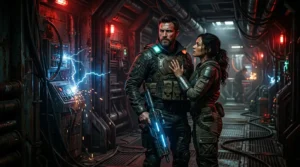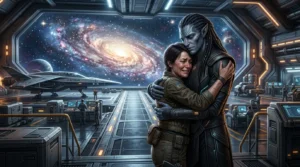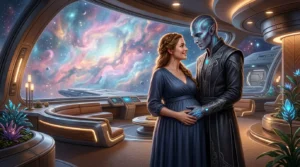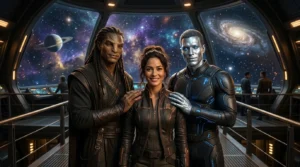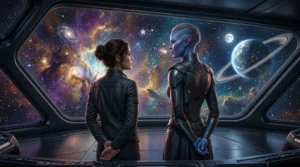
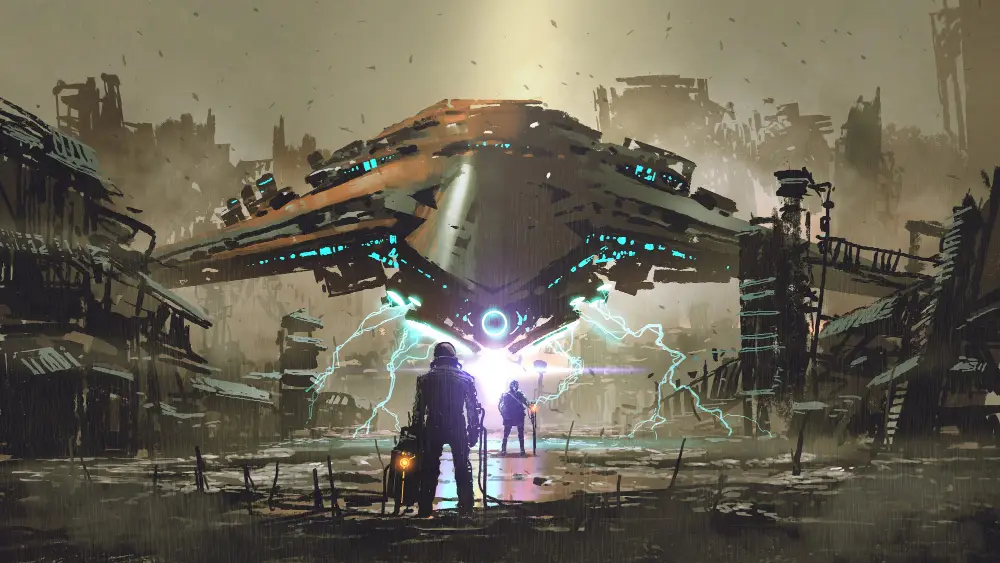
There’s a reason the enemies to lovers alien romance has its own permanent shelf on every sci-fi romance reader’s Kindle. The trope works in any genre, but something about putting it in space changes the temperature entirely. When the heroine is firing photon cannons at the hero’s ship in chapter two, and curled up in his arms by chapter twenty, you don’t just get a slow burn. You get a meltdown.
Why Conflict Hits Harder in Space
A contemporary enemies to lovers story might start with two coworkers fighting over a corner office. A sci-fi one starts with two soldiers from opposing armies trying to kill each other. The stakes are different. The wounds are real. The forgiveness, when it comes, has to be earned in a way no boardroom apology ever could.
The Body Count Raises the Bar
By the time these two characters realize what they feel for each other, blood has already been spilled. People they loved are dead because of the other side. The hero might have personally killed the heroine’s best friend three planets ago. That history isn’t a footnote. It’s the entire emotional architecture of the book.
Hate That Survives First Contact
In a good enemies to lovers alien romance, the first time they meet face to face does not melt the hatred. She still wants him dead. He still has orders to capture her. The chemistry sneaks in around the edges. Her hand shakes when she’s holding the gun to his head. He notices things about her face he shouldn’t be noticing. The tension is unbearable, and that’s exactly the point. Readers know going in that the hate has to last. The moment one of them softens too soon, the book loses its grip on the reader entirely.
The Ship-to-Ship Battle as Slow Burn
Most readers don’t think of space combat as romantic. The good authors do. A dogfight between two starfighters is two people trying to outthink each other, predict each other’s moves, push each other to the breaking point. That’s the same skill set you need for chemistry to work.
Anticipation Lives in the Reticule
He locks his targeting computer onto her ship and hesitates. She feels it. She feels him watching her. She knows in that half-second of hesitation that something is wrong with his orders, with him, with the whole war. By the time they meet in person, the foreplay has been going on for chapters and neither of them named it.
Banter at Maximum Velocity
Enemies to lovers requires good banter, and sci-fi gives writers a playground to write in. Insults across comm channels. Threats in alien languages. A war room argument that goes from “I’ll see you executed” to “I’ll see you tonight” without either character clocking the shift until the reader has already screamed into a pillow.
The Power Imbalance That Keeps Resetting
In an enemies to lovers alien romance, the upper hand keeps changing. She captures him in chapter five. He escapes in chapter eight. He captures her in chapter twelve. By the time they’re allies, neither one of them has the clean position of power. They’ve both been bound, both been bargained over, both been the one with the knife. That equity is what makes the love story land.
Trust Built on Mutual Surrender
A romance where one person keeps holding the power forever feels off to modern readers. The enemies to lovers structure gives both characters the chance to lower their weapons and then pick them back up. Each time they choose to lower them again, the bond gets stronger. By the time they say the L-word, they’ve already proven it forty different ways.
Why This Trope Translates Across Cultures
Romance readers in every language have their own version of enemies to lovers. The sci-fi setting strips away the cultural specifics and lets the conflict be about something everyone recognizes. War. Loss. The cost of loving someone you were taught to hate. That kind of story moves across borders because the emotional engine doesn’t need translation.
Aliens Make Forbidden Love Hit Harder
When the hero is from a different species, the forbidden element has weight no class-divide romance can match. He shouldn’t be able to love her. Her body chemistry, her lifespan, her cultural framework all argue against it. He loves her anyway. That refusal of biology and politics is the romantic ideal at its most concentrated.
What Modern Readers Want From the Trope
The enemies to lovers alien romance has aged well because authors keep updating it. The newer books don’t soften the conflict. They sharpen it. The hero doesn’t get to apologize his way into her bed. He has to do the work. The heroine doesn’t melt at his first soft look. She holds the line until he proves something to her that he hasn’t proven to anyone.
Earning the Soft Moments
The payoff in this trope is not the first kiss. It’s the moment when one of them lets their guard down for the first time and the other one chooses not to use it as a weapon. That choice, made by a person who had every reason to twist the knife, is what makes readers cry. Authors who structure their book around earning that moment are the ones topping the charts in 2026. The ship-to-ship battle is just the beginning. The real war is internal, and the only way out is together.